Colorado Multi-Member A-Corp Operating Agreement
Colorado won’t be able to process A-corp filings until early 2027, but multiple creatives can still build a business that provides them with A-corp style protections. Instead, you can build a custom operating agreement that works overtime for you.
Colorado’s LLC Act outlines the baseline protections that every LLC gets, while your multi-member operating agreement covers everything specific to running a company as a group, including who has the authority to make key decisions and how disagreements are handled. When modeled after the Colorado Artist Company Act’s provisions, your custom operating agreement can pick up where the law leaves off and lock in artist control for a budding, creatively driven business.
Do I Need An Operating Agreement For My Multi-Member LLC?
Your operating agreement won’t be filed anywhere or show up in your tax paperwork; it’s a private document used internally to outline the rules of your LLC. While there isn’t a law requiring you to put together an operating agreement, it’s irreplaceable when you have multiple members sharing authority in your artist LLC. It covers everything from how much voting power artist-members hold compared to non-artist-members, what each member is responsible for doing, and what happens if someone wants to leave or stops holding up their end.
Banks and lenders also often want to see an operating agreement before they’ll open a business bank account. And for an artist-run company, specifically, a well-drafted operating agreement is the fastest way to build A-corp style protections before the actual entity type is ready for filing.
Nothing in your operating agreement has the power to override state or federal law, however. Members still need to work within the Colorado LLC and Artist Company Acts, and breaking the law is still breaking the law, even if you allow it in your operating agreement.
Start Your LLC Today!
 GET STARTED

What Goes Into A Multi-Member Operating Agreement?
When ownership is shared among multiple members, the rules need to reflect that: how ownership splits, what each member is responsible for, and how the group makes joint decisions. Of course, the fundamentals remain, including member information, a business purpose (tied to an artistic mission, in an artist LLC), and what happens if the company ever dissolves.
Multiple owners also raise the stakes on the core protections of the Colorado Artist Company Act that our template aims to replicate. Reversionary rights bring your work back to you if the company ends, and the 51% artist-ownership floor keeps governance with artist-members specifically, even as membership changes, roles shift, or non-artist members join. Here’s what our template covers.
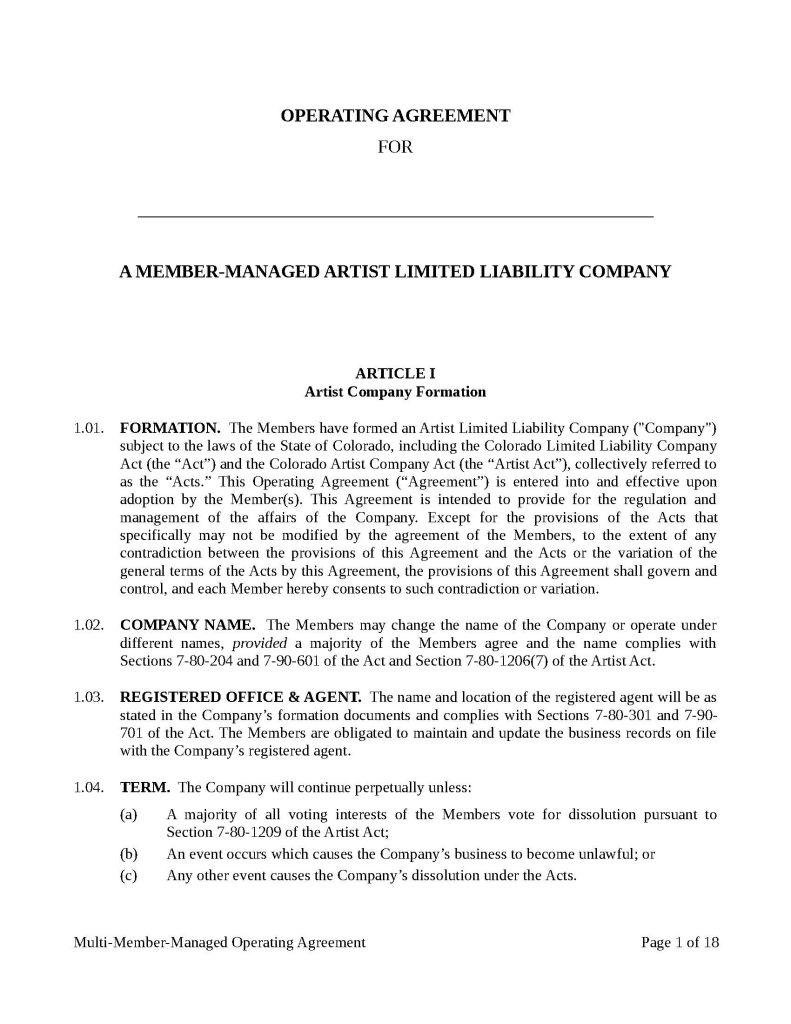
Article I: Artist Company Formation
Article I lays the groundwork for your multi-member A-corp:
- Affirms that your team has formed an LLC subject to both the Colorado Limited Liability Company Act and the Colorado Artist Company Act, and that your operating agreement governs your LLC except where it would conflict with those acts
- Points to where your registered agent, principal place of business, and member details are recorded in your formation documents
- Ties your business purpose to your company’s artistic mission
- Covers what can end the company, whether members vote to dissolve it or another event triggers dissolution, and how the business carries on if even a single member remains
- Separates artist-members, who hold governance and control, from non-artist members, and sets the requirement that artist-members hold at least 51% of voting power
- Covers how members can cast votes on company decisions
Article II: Capital Contributions
With multiple founders, your initial capital is really the sum of what everyone brings to the table: cash, equipment, or other assets, each converted into that member’s ownership stake.
The Colorado Artist Company Act expands what counts as contributions to things like grants, investment instruments, royalty sharing rights, and artistic work. The last category comes with a built-in safeguard called “reversionary rights,” which means that ownership of artistic work reverts back to the artist who contributed it should the company dissolve.
You’ll list your contributions on page 17 of our template.
Article III: Profits, Losses, and Distribution
This section covers how and when members get paid. Profits and losses get tallied once a year, and it’s on the members to decide when and how much of the available funds actually go out the door, as long as the company’s debts and expenses are covered first. Artistic work can count as a payout too, distributed in kind instead of cash, but only if every member agrees ~~to it~~ and the work’s fair market value is set first.
Article IV: Management
Article IV covers two different things: who handles daily operations like paying bills or managing contracts, and who gets a say in bigger company decisions like approving an annual budget. Your members elect one of their own as a Chief Executive Member to handle daily operations, while every other artist-member keeps a hand in the business unless the group votes to restrict that authority.
This section also splits governance by member type. Artist-members hold full authority over company decisions, while non-artist members are entitled to payouts (called LLC distributions), record access, and meeting notice, but don’t have a say in governance.
This is built around the Colorado Artist Company Act’s provision that requires governance to remain with artist-members, who must hold at least 51% voting power. Specific member duties are also outlined in this section, with consequences including loss of membership for those who fail to do their fair share.
Article V: Compensation
Money talks, but only if it’s in writing first. This next article confirms that members are entitled to compensation for services they provide to the company, but the value has to be set unanimously by every member, not just a majority. Expense reimbursement works the same way: members can individually dispute an expense as unreasonable, and if they do, it’s not paid.
Article VI: Bookkeeping
Bookkeeping for your business is a team effort in a multi-member LLC. Capital and distribution accounts need to be set up for each person, and the team must collectively keep track of formation paperwork, meeting minutes, and retain three years of tax returns and financial statements. Once the year closes, each member gets a statement of income and expenses for tax purposes.
Article VII: Transfers
If a member wants out of the business, they can’t just walk away with a check. First, they need to offer their membership interest for the other members to purchase, with a 60 day window to do so. If members choose not to purchase, but the departing member has an outside buyer, that sale still needs member approval, and artist-members can’t fall below 51% ownership due to the sale.
If no buyers are present, an independent appraisal sets the value, and that payout becomes a debt, paid gradually out of company profits.
Article VIII: Dissolution
This article covers the process for dissolving the LLC. Generally, a member vote needs to be held to dissolve the company, though other events can trigger dissolution automatically, such as the company having no members for 90 consecutive days. Note: dissolution cannot be forced by someone who only holds economic interest without full membership rights.
When the company is dissolved, artistic work goes back to whichever artist-member created or contributed it. Afterwards, once debts and obligations are paid, remaining assets are distributed among members.
Article IX: General Matters
Rounding out your operating agreement is a section that covers basic legal housekeeping. This includes how the document binds members and their successors, how amendments to the operating agreement require a vote, and how disputes are resolved. It also spells out exactly how formal notices between members and the company have to be delivered and routed through the Chief Executive Member, and confirms that Colorado’s LLC and Artist Company Acts govern the LLC over all else.
Certification of Members
This section is where your creative collective signs on the dotted line. By signing, every member formally adopts and approves the operating agreement, and confirms their individual ownership percentage.
Exhibits
The exhibits section of your operating agreement is where the specifics get filled in. Here, you provide a list of your members (artist-members vs non-artist members), their duties, as well as the value of their capital contributions.
Resolution to Open a Bank Account
Most banks and financial institutions require a bank resolution to open a business account. Our template includes one for free. This separate document certifies that your members are authorized to act on the company’s behalf for banking purposes, and designates the bank to hold your funds.
Why Does My Artist LLC Need a Multi-Member Operating Agreement?
Multiple owners running a creative business together are especially likely to find themselves entangled in disputes. That’s why it’s important to clarify who owns what art, who’s pulling their weight, or how creative decisions get made.
With a custom operating agreement in place, each of these points gets covered in writing, keeping your company running smoothly and lessening the likelihood of unresolvable disagreements.