Colorado Single-Member A-Corp Operating Agreement
A-corps won’t be available for filing until early 2027, but solo artists don’t need to wait to protect what they’re creating. A single-member operating agreement allows you to establish rules that emulate the benefits of an A-corp right now, before the new entity type even exists.
Colorado’s LLC statutes determine the fundamentals, like your asset protection, member liability, and default dissolution rules. A custom operating agreement picks up where the law leaves off.
Do I Need An Operating Agreement For My Single-Member LLC?
Unlike your Articles of Organization, an operating agreement is an optional, internal document that you won’t need to file with any official state agency. That said, an operating agreement has the power to write the rules that your LLC abides by—including dictating what happens if the company dissolves, or what assets are contributed to a new company.
Furthermore, many banks and lenders require an operating agreement to open a business bank account. For artist companies, a well-drafted operating agreement is also the most practical and inexpensive way to establish A-corp-style protections before the new entity type is available for filing.
Keep in mind, your operating agreement can’t supersede state or federal law, and it won’t excuse illegal behavior just because something is permitted in your operating agreement. The Colorado LLC Act, along with federal law, set the boundaries. Your operating agreement works within them, not around them.
Start Your LLC Today!
 GET STARTED

What Makes Up A Single-Member Operating Agreement?
Much like a standard LLC operating agreement, your artist LLC’s operating agreement must include several key components, including member names, business purpose, and principal place of business.
Where your artist LLC operating agreement differs is in its A-corp-specific provisions. This includes an artistic mission requirement, built-in intellectual property (IP) reversionary rights, and artist-ownership requirements. Intellectual property—the recordings, manuscripts, or other creative work you produce—is at the heart of what separates an A-corp operating agreement from a standard LLC.
Here’s what our template covers.
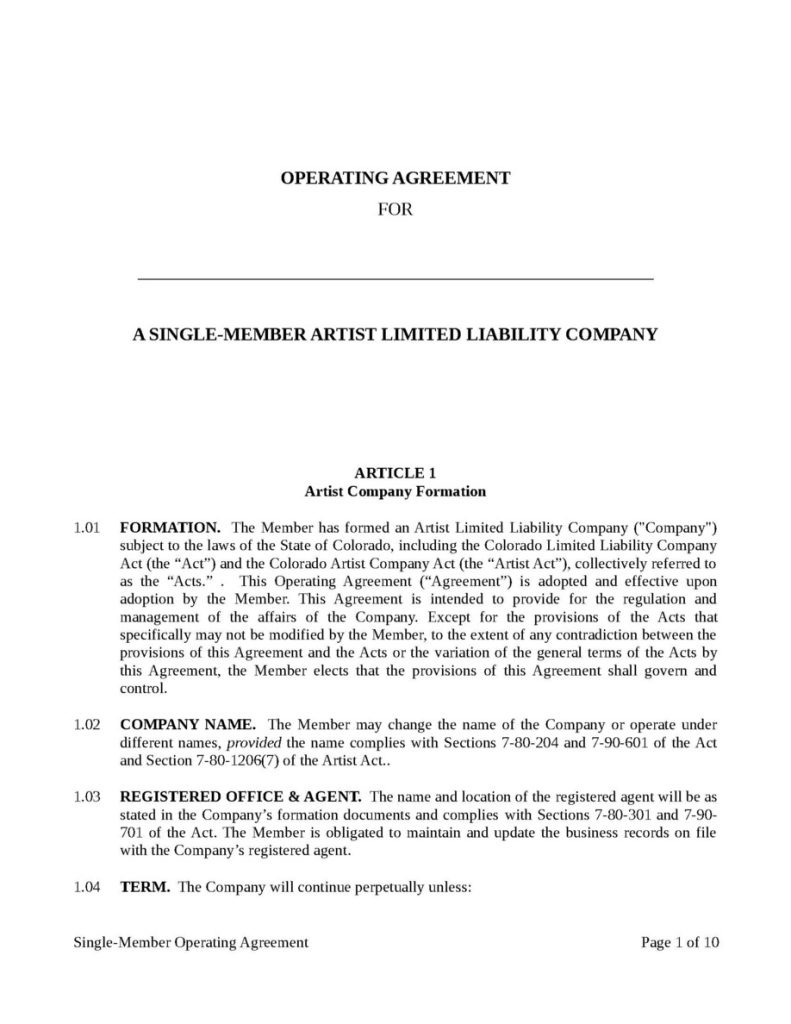
Article 1: Artist Company Formation
The first section of your single-member Artist Company operating agreement serves several functions:
- Affirms that the LLC has been formed under both the Colorado Limited Liability Company Act and the Colorado Artist Company Act, and states that this agreement governs the LLC except where it would conflict with the provisions of ~~those~~ acts that cannot be modified
- Explains the rules for changing the Company’s name, and where to find registered agent and principal place of business details
- States the requirement for a business purpose to support or further the artistic purpose of the company
- Explains the company will exist in perpetuity unless the member elects to dissolve it, the business activities become unlawful, or another event causes dissolution under the Colorado Limited Liability Company Act
- Explains what a member is, how new members can be added, and the requirements a prospective member must meet to join
Article 2: Capital Contributions
As the sole owner, you’ll fund your LLC with money or other assets in exchange for your ownership interest. Under the Colorado Artist Company Act, contributions can take a variety of forms, including grants, investment instruments, royalty sharing rights, and artistic work itself.
You generally can’t withdraw your contributions outside of normal LLC payments, which are called distributions, or when the company dissolves. Artistic work is handled through reversionary rights, which grant you a claim to anything you contributed if the company dissolves.
You’ll list your initial contributions on page 9 of our template.
Article 3: Profits, Losses, and Distribution
A fan favorite: this section describes how and when you as the owner get paid by your business. Profits and losses are determined on an annual basis, and once expenses and liabilities are covered, you can distribute available funds whenever you see fit.
Your artist company can also distribute assets in kind, meaning things like artistic work can be considered a payout so long as a fair market value has been set first.
Article 4: Management
As the sole member of your LLC, you run the show when it comes to management. This section of your operating agreement covers your powers and duties in that role: managing daily operations, making decisions regarding company assets and contracts, and binding the company through signed agreements. The provisions of the Artist Act keep voting power at least 51% artist-held, even as a company grows. Being the sole artist-member in your LLC, you’re already in alignment with all these provisions.
This section also protects you from personal liability for the company’s debts and obligations, so long as you’re acting in good faith and within the terms of the agreement.
Article 5: Compensation
While it might be hard to separate yourself from your work as an artist-turned-business-owner, your LLC is still a legally distinct entity from you as an individual. This article confirms that you’re entitled to compensation for the work you do and reimbursement for any out-of-pocket expenses you incur while managing it. Your creative labor counts here just as much as administrative work, a distinction that matters for an artist company.
Article 6: Bookkeeping
This article explains how you’ll maintain financial records for your company, including capital and distribution accounts, formation documents, and your last three years of tax returns and financial statements. Once your financials close up each year, you’ll put together a summary of your income and expenses for tax purposes. It might feel unnecessary as the sole member, but it’s what keeps your paperwork consistent when tax season arrives or a lender comes calling.
Article 7: Dissolution
This section covers what happens if you sell your interest in the company, or if the company closes its doors entirely, and what either situation means for you as the sole member. Simply put, it explains:
- That you can sell, assign, or otherwise dispose of your interest in the company, but any sale cannot drop artist-members below 51% voting control or violate reversionary rights
- That you can dissolve your LLC at any time, and that the company automatically dissolves if there is no member for 90 consecutive days
- That upon dissolution, rights to any artistic work you created or contributed to the company revert to you, and that the company must pay its debts before making any distributions to you
Article 8: General Matters
This closing article serves as standard legal housekeeping for your operating agreement. It covers how your agreement binds you and your successors, how it can be amended, how disputes or invalid provisions are handled, and affirms that Colorado law, notably the Colorado LLC and Artist Company Acts, governs your LLC over all else.
Certification of Sole Member
This section is where you certify yourself as the sole member of your LLC. Signing it confirms you’ve formally adopted this operating agreement. This section also records your ownership percentage (100%, in this case) and personal address.
Exhibit: Capital Contributions
As referenced above, this is where you record the value and a breakdown of your initial contributions. You’ll sign and date this section as well.
Resolution to Open a Bank Account
Our template also includes a free bank resolution, a separate document many banks require in order to open a business account for your LLC. It certifies that you’re authorized to act on the company’s behalf and designates the financial institution to hold your funds.
How Does an Artist Company Protect My Work?
You don’t need to wait until A-corps are available to protect your art with an LLC. By modeling your operating agreement on the Colorado Artist Company Act’s provisions, you can create A-corp style protections today, and carry them forward once the entity type is available.
With stipulations like artist ownership requirements and reversionary rights written into your operating agreement, you’re safeguarding your work and your rights as an artist today, protections you’d otherwise have to wait for.