Colorado Manager-Managed A-Corp Operating Agreement
Artist companies, or A-corps, won’t be available for formation until early 2027 in Colorado, but creatives don’t need to wait to protect what they’re building. A custom operating agreement for your manager-managed LLC lets you put A-corp-style protections in place today, whether you’re a solo creative handing daily operations to a hired manager, or a team of co-owners doing the same.
Colorado’s LLC statutes cover baseline protections: liability shielding, asset protections, and default dissolution rules. Your operating agreement builds on top of those laws, and for a manager-managed company, it’s also where you’ll define who runs your business day to day, while locking in artist control in the long run.
Do I Need An Operating Agreement For My Manager-Managed LLC?
Like any operating agreement, this one is an internal document. You don’t need to file with any state agency or include it with your tax filings. But, it’s what actually governs how your company runs day to day. For a manager-managed company, this matters in a very specific way: keeping artist control locked in no matter who’s running daily operations, so management and member authority doesn’t collide later.
Banks and lenders often want to see this document before opening a business account, and for artist companies, a well-drafted operating agreement is the most practical way to build A-corp-style protections before the entity type itself is available for filing.
It’s important to note, your operating agreement still can’t override Colorado or federal law. Even provisions your members formally agree to are subject to whatever the Colorado LLC and Artist Company Acts say can’t be modified, and illegal acts can’t be excused just because your operating agreement says so.
Start Your LLC Today!
 GET STARTED

What Makes Up A Manager-Managed Operating Agreement?
A manager-managed operating agreement covers the same foundational ground any LLC operating agreement does, including member and manager information, dissolution plans, and what authority is afforded to members. It also sets requirements around your business purpose, tying it to your artistic mission. With dedicated management and the potential for multiple members, though, there’s more to document: how ownership breaks down across members, who’s authorized to manage the company on their behalf, and how decisions are made when members don’t agree.
The A-corp-specific provisions carry over too: an artistic mission requirement tied to your business purpose, built-in reversionary rights protecting your work in the case of dissolution, and a 51% artist-ownership requirement. In a manager-managed company, that provision keeps company control with artists even when day-to-day management sits with someone else. Here’s all that our template covers.
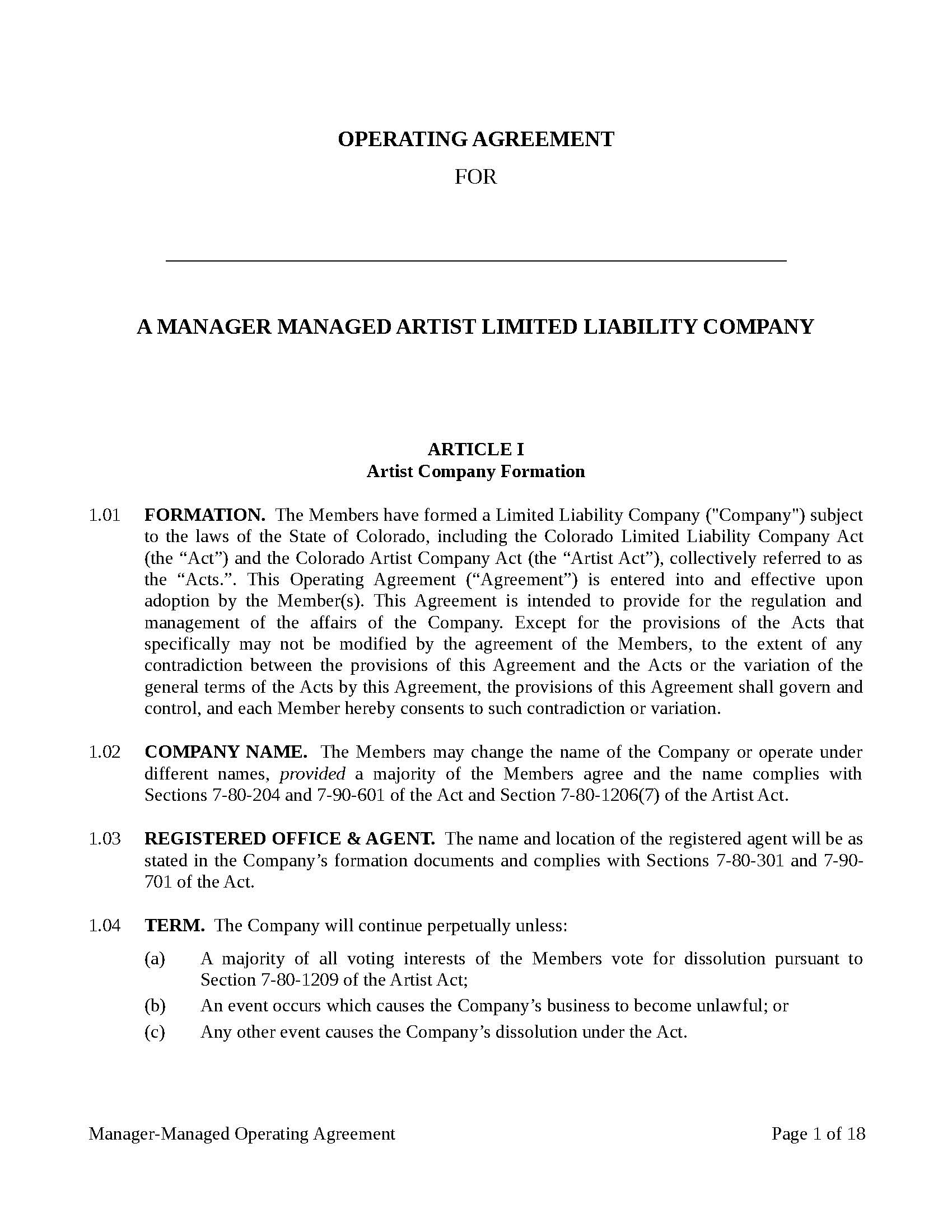
Article I: Artist Company Formation
The first section of your manager-managed A-corp operating agreement establishes a few things at once:
- Affirms that the LLC has been formed under both the Colorado Limited Liability Company Act and the Colorado Artist Company Act, and states that this agreement governs the LLC except where it would conflict with provisions of those acts that cannot be modified
- Notes where key business information, like member and manager details, registered agent, and principal place of business, can be found
- States the requirement for a business purpose to support or further the artistic purpose of the company
- Lists the events that can dissolve the company, including a member vote, and explains how the business can continue if at least one member remains
- Explains how new members can be added, while keeping Artist-Members at 51% or more of voting power, and how members vote on company decisions
Article II: Capital Contributions
Each member funds the LLC with money or other assets in exchange for ownership interest, alongside whatever the other members contribute. Under the Colorado Artist Company Act, contributions can also be grants, investment instruments, and royalty sharing rights. Artistic work itself is also considered a contribution, and is protected by reversionary rights if the company is dissolved.
You’ll list your contributions on page 17 of our template.
Article III: Profits, Losses, and Distribution
This section covers how and when you and other members get paid. Profits and losses are determined annually, and once expenses and liabilities are covered, the managers can distribute available funds as they see fit.
Your artist company can also distribute assets in kind, meaning things like artistic work can be considered a payout so long as all members agree to it and fair market value is set prior to distribution.
Article IV: Management
This article covers how your company is run day to day, and by whom. It grants your managers authority over daily operations, company assets, and the power to bind the company through signed agreements. This also distinguishes between how non-managing members have compared to managing ones.
Article IV also ties management authority back to the Colorado Artist Company Act, which requires artist-members to hold at least 51% of governance and voting control, even as managers handle operational and financial authority.
Article V: Compensation
Managers, like members, appreciate being paid for their efforts. This next section of your operating agreement confirms that managers are entitled to compensation for services they provide, with the value determined by member vote, as well as reimbursement for out-of-pocket expenses incurred while running the company.
Article VI: Bookkeeping
Since managers are running the show, they’re responsible for keeping the books in order. This article explains how your managers will maintain financial records for the company, including capital and distribution accounts for each member, formation documents, meeting minutes, and your last three years of tax returns and financial statements. At the end of each year, managers prepare and send each member a report of their share of income and expenses for tax purposes.
Article VII: Transfers
This article covers what happens if a member wants to leave. It explains:
- The rights that remaining members have regarding the sale of membership interest, specifically describing their right to have first opportunity to purchase the membership interest of the departing member.
- How the departing member’s interest is valued if there’s no outside buyer, typically through independent appraisal, and what happens if the remaining and departing members can’t agree on a price.
- That the company isn’t required to pay out the value of the membership interest all at once, and that the amount due is instead treated as debt paid over time.
Article VIII: Dissolution
Sometimes, you have to know when to say goodbye. The eighth article of your operating agreement covers what happens if the company dissolves. Members can vote to dissolve the company at any time, and the company automatically dissolves on its own if there are no members left for 90 consecutive days.
Upon dissolution, rights to any artistic work revert to the artist-member who created or contributed it. Afterwards, the company can pay remaining distributions to members once debts and obligations are covered.
Article IX: General Matters
This final article serves as the typical legal housekeeping your operating agreement needs. It covers how your agreement binds members and their successors, how it can be amended through member vote, and how disputes or invalid provisions are handled.
This section also defines how formal notices between members and the company get delivered, and affirms that Colorado law, notably the Colorado LLC and Artist Company Acts, governs your LLC above all else.
Certification of Members
This is your signature page. Every member needs to sign here to formally adopt this operating agreement, whether there’s one member or 10. Your manager will also sign in the exhibits section below, under “Listing of Managers.”
Exhibits
Exhibits are the fill-in-the-blank sections found at the end of your artist company operating agreement. These forms list your managers, members (including who qualifies as an artist-member) and their ownership percentage, and the value of each member’s capital contributions.
Resolution to Open a Bank Account
Our template includes a free bank resolution with your operating agreement. This separate document is required by many banks before they’ll open a business account for your LLC. It certifies that your members or managers are authorized to act on the company’s behalf and designates the financial institution to hold your funds.
Why Choose a Manager-Managed Structure For My A-Corp?
A manager-managed structure allows members to delegate daily operations and business decisions to a manager, whether that’s a fellow member or an outside professional. This allows busy creatives to focus on their work. Delegating management doesn’t give up control, especially with the built-in artist control that your operating agreement establishes.