10 Most Expensive States to Start a Business (2026)
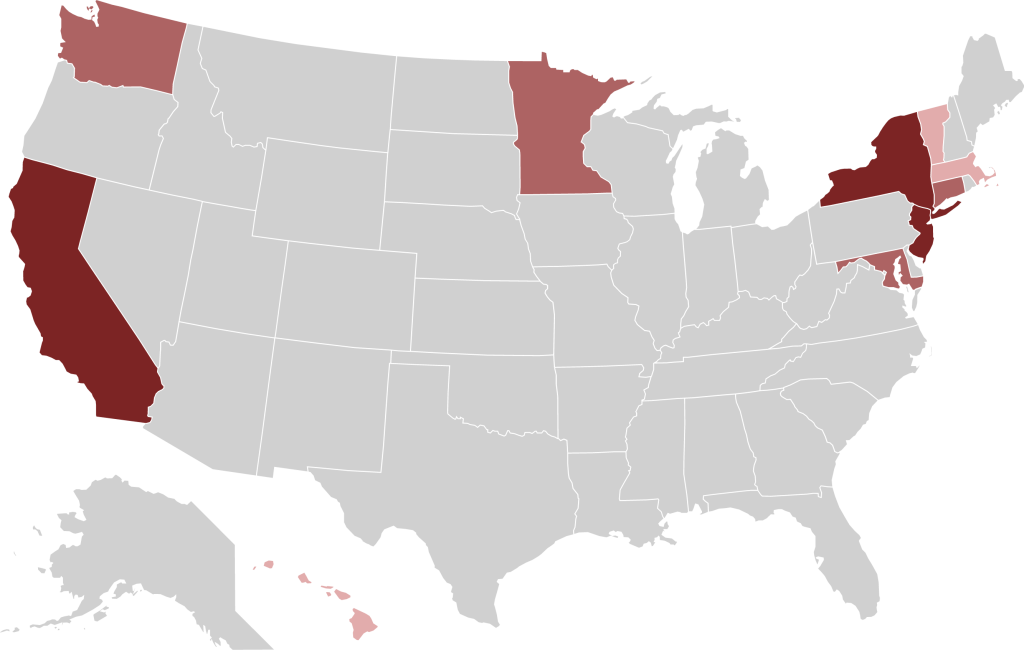
Starting a business is hard enough, and your state shouldn’t make it harder. Choose the right home base and you’ll enjoy a tax climate that actually supports growth and offers lower recurring costs to help you stay lean in the early days. Choose poorly, and you could get hit with a wall of steep state fees, high minimum wage costs, and licensing hoops that siphon off your revenue before you can turn a profit.
If you want to balance real economic opportunity with policies that won’t weigh you down, it helps to know which states create the toughest climb. In this guide, we break down clear, public data on state taxes, recurring fees, wage requirements, and licensing barriers to spotlight the most expensive states to start a business in 2026. Plus, we’ll explain what you’ll need to plan for if you decide to launch there anyway.
Earlier this year, we covered the Top 10 Affordable States to Start Your Business. Get the full picture by weighing those states against the ones reviewed here.
Choosing Your Formation State
Depending on the type of business you’re launching, the “right” state will depend on several factors. If you’re opening a physical storefront, plan to hire local employees, or provide in-person services in your home state, you’ll need to form your business in the state where you’re actually located.
On the other hand, if your business operates exclusively online, such as an e-commerce company, and has no physical presence, you may have more flexibility to compare states and choose the one with the most business-friendly environment.
Keep in mind that if your activities meet another state’s definition of doing business, you’ll also have to register there, potentially doubling your filings and annual fees. Consult an attorney if you’re unsure.
Key Expenses To Consider
It’s easy to fixate on minor details, but when you consider the options of where to plant your business flag, focus on the factors that make a large impact on your budget over time. These include:
- Recurring state fees: Annual state reports (sometimes biennial) and the fees to file them
- Tax exposure and complexity: Corporate and/or personal income tax rates, franchise and state minimum taxes, and layered structures.
- Licensing and permitting costs: The upfront and renewal costs for the basic permits you need to operate
- Minimum wage floor: The baseline that shapes payroll from day one for any type of labor or talent that you’ll hire
- Extra requirement costs: Publication costs, regional tax surcharges, and other state-specific expenses
Watching out for these added costs is an easy way to compare states and identify the home base that will work best for you.
State-by-State Cost Ranking for New Businesses
Drawing on the Tax Foundation’s 2025 State Business Tax Climate Index, plus publicly posted minimum wage and annual report costs, we ranked the 10 toughest states for new businesses in descending order. If you operate in one of these states or plan to form your LLC or corporation there, expect the following hurdles and budget accordingly.
10. Massachusetts
Massachusetts is home to Harvard University and dozens of other top colleges, which helps create an exceptionally well-educated workforce. Unfortunately, it is consistently one of the pricier states for new businesses, maintaining a “best of the worst” standing in terms of affordability.
The basics:
- Startup fees: $500 for LLCs, minimum of $275 for corporations
- State minimum wage: $15.00/hr
- Annual report fees: $500 for most entities, $100 for corporations (if filed online)
- Tax rates: 8% depending on the industry, with a minimum of $456 for corporations
Why it’s expensive:
Massachusetts’ complicated corporate tax structure, which varies based on your industry, coupled with one of the U.S.’s highest fixed fees for business renewals, and the 17th highest property tax rate, makes for a very challenging business environment for many startups.
9. Hawaii
No one would argue that Hawaii is one of the top destinations in the U.S. Unfortunately, mild weather and beautiful scenery doesn’t translate to a favorable tax environment for new businesses.
The basics:
- Startup fees: $51 (including $1 State Archive Preservation Fee)
- State minimum wage: $14.00/hr
- Annual report fees: $12.50-$15.00
- Corporate tax rates: 4.4-6.4% + 4-4.5% general excise tax (GET)
Why it’s expensive:
While the startup and ongoing state fees aren’t going to break the bank, the tax structure will hit your company wallet hard. A minimum 4.4% corporate tax, plus a minimum 4% GET makes for steep tax exposure. This GET is charged at every level in a supply chain as well, leading to “tax pyramiding” where a product is taxed multiple times before reaching the end consumer.
Along with that, Hawaii levies one of the highest individual tax rates in the country, up to 11% for high-earners, along with relatively high living expenses, all thanks to the state’s isolation from the mainland.
8. Vermont
Vermont’s costs add up fast: consistently higher property taxes and steep individual income tax brackets mean you’ll need to prepare accordingly if you want to operate in the Green Mountain State.
The basics:
- Startup fees: $155
- State minimum wage: $14..01/hr (increasing to $14.42/hr as of January 1, 2026)
- Annual report fees: $45-$60
- Corporate tax rates: 6-8.5% graduated corporate income tax
Why it’s expensive:
Along with relatively high tax exposure for individuals, Vermont charges most LLCs, partnerships, and S-corps a $250 Business Entity Tax (BET) each year on top of its annual report fees. This stands out from most other states, which typically treat LLCs as pass-through entities, where their profits are taxed later as part of your personal income.
7. Minnesota
Minnesota is a very straightforward filing state with $0 annual renewals. However, a flat 9.8% corporate franchise tax and a broad minimum fee which will hit many LLCs and partnerships can raise ongoing costs.
The basics:
- Startup fees: $135
- State minimum wage: $11.13/hr
- Annual report fees: $0 for domestic entities
- Corporate tax rates: 9.8%
Why it’s expensive:
Minnesota’s corporate tax, called a franchise tax, is among the nation’s most costly, and it applies to most entities. This creates a higher minimum on what you’ll owe, even in years where your business profits are low.
6. Washington
Don’t let Washington’s lack of a traditional corporate income tax fool you: the state makes up for this lost revenue with a Business and Occupation (B&O) tax that is applied to gross revenue.
The basics:
- Startup fees: $180-200
- State minimum wage: $16.66/hr, some cities set higher minimum requirements
- Annual report fees: $70 for most businesses
- Corporate tax rates: 0% corporate income tax, but a B&O tax is levied on gross receipts
Why it’s expensive:
Washington’s B&O tax applies to gross receipts, not profits. This means your business will owe the state money even if your company barely breaks even, or worse, is unprofitable entirely. This is an uncommon feature among states in the U.S., as only six other states apply a state-level B&O tax to businesses.
5. Maryland
Maryland has straightforward filings but a complicated tax setup and high annual report fees, which raise operating costs considerably.
The basics:
- Startup fees: $100-$176 depending on entity type and filing method
- State minimum wage: $15.00 depending on location
- Annual report fees: $300 + Personal Property Tax
- Corporate tax rates: 8.25%
Why it’s expensive:
For multi-state companies operating in Maryland, the state uses single-sales-factor apportionment. Translation: More Maryland sales means more Maryland tax (even with a small in-state footprint).
Plus, you’ll need to separate your Maryland sales and calculate your liability based on their weighted tax formula. Maryland’s required personal property return also adds a recurring filing and potential tax on basic equipment like computers and office furniture.
4. Connecticut
Connecticut is another state that benefits from a highly skilled labor market, but one which suffers from a high wage floor and pricey startup fees for corporations.
The basics:
- Startup fees: $120 for LLCs; $250 for corporations plus $150 for Organization and First Report Form
- State minimum wage: $16.35
- Annual report fees: $80-$150 depending on entity type
- Corporate tax rates: 8.25%
Why it’s expensive:
Beyond an expensive launch for corporations, high earning companies will also face a 10% surtax applied to their tax dues. This is on top of an already steep tax rate (for comparison, many states don’t have state corporate income tax at all, or they keep rates lower, usually between 2-5%).
3. California
When business owners talk about operating in California, the state’s $800 annual franchise tax is one of the first things to come up. This pre-profit expense often deters potential business owners from choosing the state, especially if they have other options.
The basics:
- Startup fees: $30-$150 depending on entity type and stock shares issued, plus $800 franchise tax fee within 4 months
- State minimum wage: $16.50
- Annual report fees: Corporations: $25 annually; LLCs: $20 biennially
- Corporate tax rates: 8.84%
Why it’s expensive:
Almost immediately after forming your business, your $800 franchise tax is due. On top of this, many LLCs will pay additional fees thanks to the state’s gross receipts tax. Pair all this with one of the country’s highest wage floors, according to Paycor, and California is a state that will cost you big before you even get started.
2. New Jersey
Only one state is more expensive than New Jersey, according to the Tax Foundation’s index. The Garden State has continued to rank low in terms of affordability, thanks to a complicated, multi-tiered tax system and some of the highest base tax rates in the country, both for businesses and individuals.
The basics:
- Startup fees: $125
- State minimum wage: $14.53-$15.49, depending on the number of employees
- Annual report fees: $75
- Corporate tax rates: 6.5-9%, plus a $375-$500 minimum for many businesses
Why it’s expensive:
Businesses of every size face minimum gross receipts taxes in addition to regular annual report fees. Larger companies will also pay an additional 2.5% Corporate Transit Fee. And it’s important to note, tax credits cannot be applied to the liability, pushing effective tax rates as high as 11.5%.
1. New York
A huge market with equally huge baseline costs. New York’s high wage floor and LLC publication requirement are the biggest factors that business owners should be aware of.
The basics:
- Startup fees: $125-$200 + publication fees
- State minimum wage: $15.50
- Annual report fees: $9 biennially
- Corporate tax rates: 6.5%-7.25%
Why it’s expensive:
New York is consistently one of the least affordable states for someone to launch a business. If you’re considering forming in The Empire State, be aware of New York’s LLC publication requirement (which costs between $600-$2,000), high minimum wage, and skyrocketing living expenses.
Saving Your Startup From Pricey States
So, don’t let your first big business decision sink your launch. Even if you find yourself in one of the most expensive states to start a business, you can still succeed—just budget carefully, lean on the data, and move deliberately. Thoughtful planning now can turn what looks like a hurdle into a manageable part of your growth journey.