Top 10 Affordable States to Start Your Business
Starting a business comes with more expenses than many founders expect. From formation fees and recurring compliance reports to ongoing tax obligations, the line-items in your business budget can stack up quickly.
However, not every state carries the same price tag, and choosing the right state to form in can save your business a significant amount over time. By taking the time to review the different environments each state creates, you can identify the most cost-effective options for your startup.
Startup Formation Costs
Initial setup costs and ongoing state expenses account for the majority of expenses to consider when choosing a state in which to start a business. Initial costs include filing your formation documents, applying for required state or industry-specific business licenses, and completing any required initial reports. Ongoing expenses may include filing regular annual reports with the state, but one of the most significant considerations is business taxes.
Even seemingly minor differences in tax rates can snowball greatly over time.
For example, a business generating $200,000 in annual net income in a state with a tax rate similar to North Carolina’s 2.25% corporate income tax rate would pay significantly less over time than in a state with a higher rate, like Alabama’s 6.5% corporate income tax rate. Over a five‑year period, that difference adds up to more than $40,000 that can be reinvested into growth.
What is the average cost of forming a business?
Formation costs vary so much between states that it can be hard to determine your initial investment until you’ve pinned down which state you’re forming in. Factors like the type of business entity you’re forming can make a difference, too, since the state costs to register an LLC differ from those to form a corporation.
Generally speaking, filing your LLC Articles of Organization can cost as little as $35 or over $500, depending on the state you choose. Similarly, incorporation costs can vary from $50 to over $400. These values only represent the cost to file your formation documents, and don’t account for any initial reporting or publication fees incurred by certain states, so make sure to perform adequate research so you aren’t hit with any nasty surprises.
If the highs and lows of business formation costs have you dizzy, Northwest Registered Agent can provide one constant: our business formation service is only $39 plus state fees. Hire us to form your business. No matter where you plant your flag, we’ll guide you every step of the way.
The 10 Best States for Startups
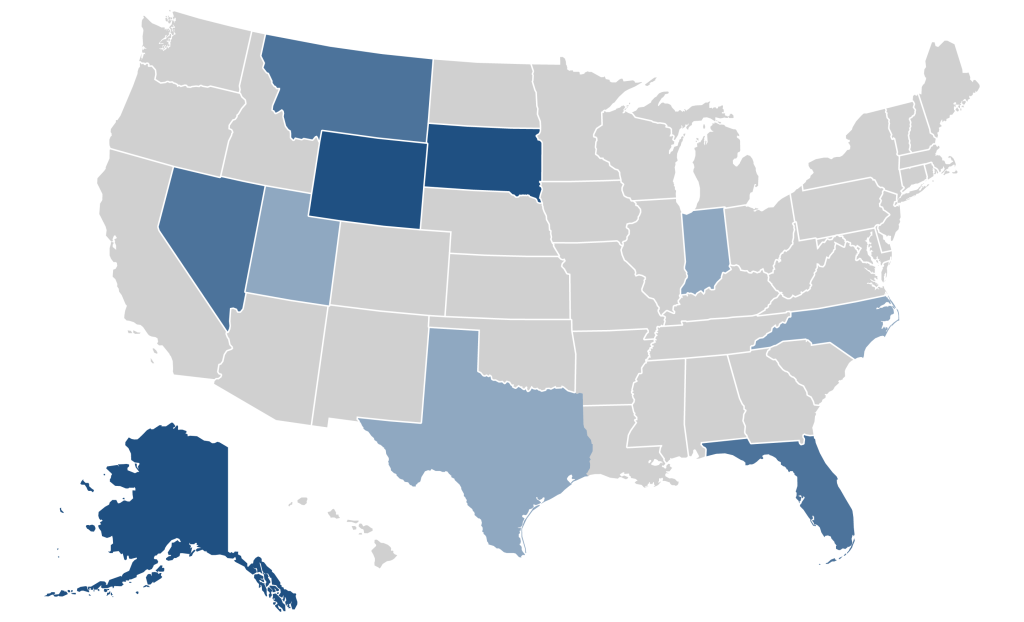
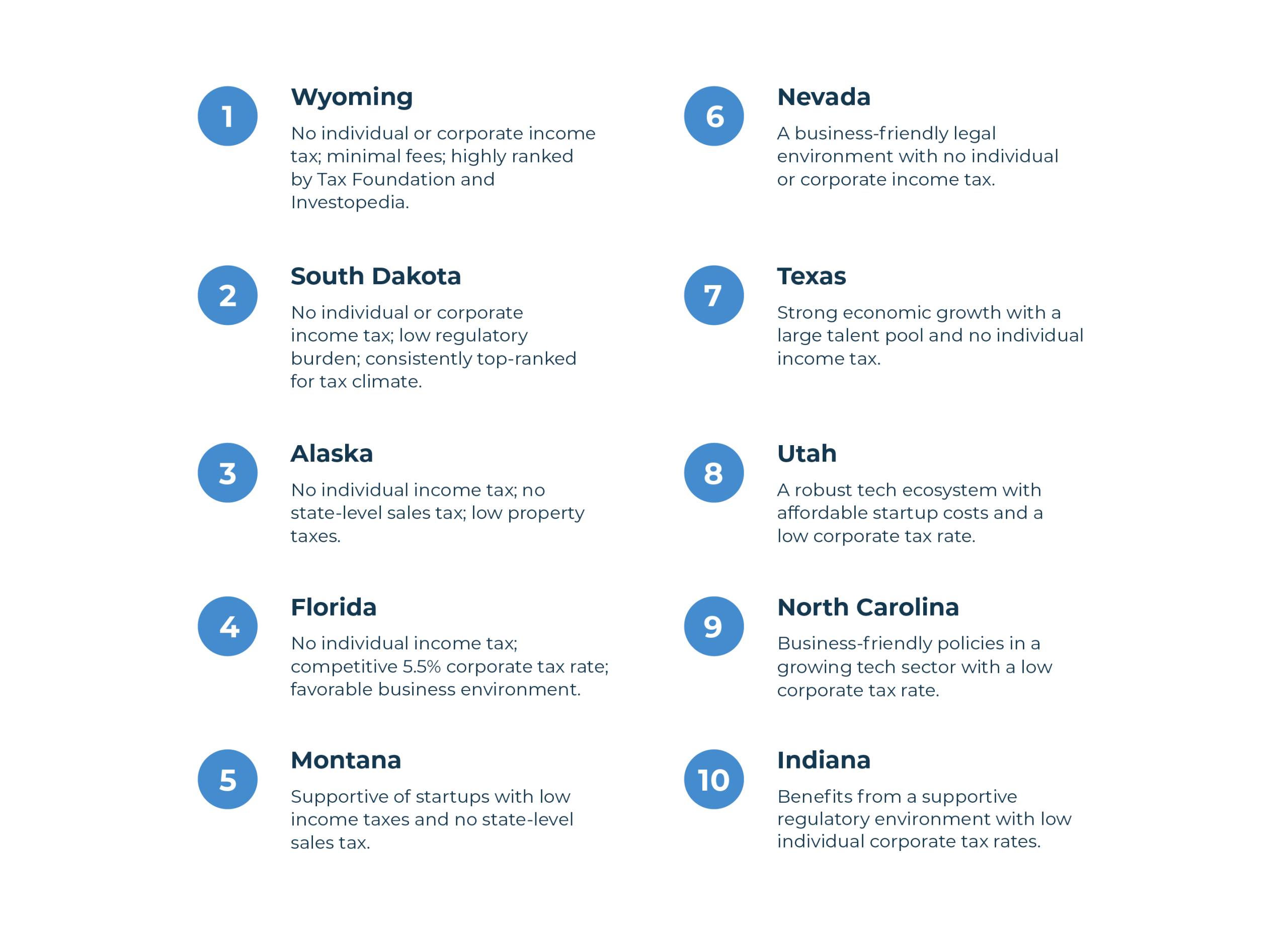
When deciding where to form your business, cost isn’t the only factor, but it’s one of the most significant. Going beyond just initial business formation costs, some states stand out in terms of affordability by combining tax advantages, lower ongoing filing costs, business-friendly regulatory systems, and statewide or regional business incentives. Here are the top picks for the most affordable states out there.
Wyoming
Wyoming is often in conversations about the most business-friendly states, and for good reason. The state has very low formation costs and imposes no corporate income tax, setting it apart from much of the country. Instead, businesses face a combined 6% sales tax at most, comprising a 4% statewide rate and varying county-level taxes. This is the primary reason the state topped the Tax Foundation’s 2025 State Tax Competitiveness Index.
Note: A few counties, like the Teton Resort District, also levy an additional 2% resort tax. This won’t apply to most businesses.
South Dakota
Like Wyoming, South Dakota boasts zero personal income or corporate tax, along with a 4.2% statewide sales and use tax, with municipalities able to tack on up to 3% through municipal gross receipts tax (MGRT) or gross receipts taxes.
The state also makes access to resources easy with its interactive financing & incentives tool, found on the South Dakota Governor’s Office of Economic Development website. This tool makes it easy to locate grants, loans, and other funding and develllopment programs.
Alaska
Alaska offers a uniquely lean tax environment: no personal income tax, no statewide sales tax, and in some municipalities, not even a property tax. Instead, you’ll be charged a sales tax by the municipality in which you set up shop, ranging from 1% to 7%. Thanks to these factors, your overall tax exposure as a business is relatively low.
As an incentive to incoming businesses, programs like the Alaska Regional Development Organizations (ARDOR) program, provide information on reduced-cost develllopment zones, or areas with regional incentives for business develllopment.
Florida
Florida levies a moderately low corporate income tax rate of 5.5%, but, like a few of the other top states on this list, it doesn’t charge a personal income tax. The state also doesn’t charge a payroll tax, leaving more money in the hands of partners and employees.
Additionally, Florida features convenient infrastructure for businesses shipping or receiving products, with 19 international airports and 14 deepwater seaports. While it’s not a number that can be quantified easily, the potential savings for certain businesses, such as those in the import sector or tech companies that frequently host international conferences in hubs like Miami or Orlando, highlight an otherwise overlooked operating expense.
Montana
$35. That’s how much it costs to start a business in Montana. This makes Montana the most affordable state in which to form a business. The state also boasts one of the highest startup densities in the country, with 422 startups per 100,000 people, according to Entrepreneur.
To top this off, Montana also eliminates sales tax altogether, although it does charge a standard corporate income tax rate of 6.75%, with a minimum tax obligation of $50 for businesses.
Nevada
Nevada shares many of the tax-friendly policies that make other states appealing for business formation; no corporate or personal income tax, and a commerce tax that only applies to businesses with revenue exceeding $4 million annually.
Along with this, Nevada has become a launchpad for startups, with programs like StartUpNV, a 501(c)3 nonprofit, helping to nurture new businesses with access to mentorship and capital.
Texas
Texas has become a magnet for big-name headquarters; not just for its lack of corporate or personal income tax and low franchise tax fees for businesses with less than $2,470,000 in revenue, but also for its sheer economic heft. The state’s economy now exceeds $2.7 trillion, a GDP that surpasses or compares to that of entire countries like Italy, Brazil, and Russia.
That kind of scale creates cost-saving advantages at every level of business. This explains why high-profile companies, including Tesla, Toyota, and Charles Schwab, have all relocated their headquarters to Texas. And while oil and gas remain economic pillars, Texas is rapidly diversifying into high-growth sectors like advanced manufacturing and AI-driven tech, making it a state that is both affordable and opportunity-rich for new business formation.
Utah
With relatively low corporate and personal income tax rates of 4.55%, down from 4.95% in 2018, Utah remains competitive with other states by offering manageable tax exposure. But affordability here goes beyond taxes.
Utah also earned an A grade in Govtech’s 2024 Digital States Survey, which recognized the state’s commitment to integrating digital infrastructure and streamline its services. This modernization helps reduce compliance friction and, by extension, the amount of cash you’ll invest in administrative overhead and downtime for regular filings, like your Utah Annual Report, and other state outreach.
As a bonus, Utah features a fast-growing tech corridor, dubbed the Silicon Slopes and anchored by cities like Salt Lake City and Provo, which is currently giving Silicon Valley a run for its money.
North Carolina
The Old North State sits on the lower end of tax rates for the country due to its flat 2.25% corporate income tax and a 4.25% personal income tax, set to drop to 3.99% after 2025. These rates translate to tangible savings for business owners, especially when paired with the state’s low cost of living and reasonable filing fees.
Something else that really sets North Carolina apart is its access to talent and business prestige. Highly regarded research institutions like Duke University and the University of North Carolina at Chapel Hill consistently produce a highly educated workforce. With all this in mind, it makes sense that CNBC has named North Carolina the Top State for Business three times in the past four years.
Indiana
Forming your business in Indiana will run you less than $100 in state fees if you file online, and you’ll see a corporate income tax rate of 4.9% as of July 1, 2021. The state also provides a comprehensive resource for finding entrepreneurial support, access to capital (an average of $24,502 per small business), state business incentives, and more on the Indiana Economic Development Corporation website.
Picking the Right State for Your Business
Making a strategic decision about where to form your business can impact your bottom line for years to come. Ongoing tax burdens, access to venture capital, and hefty compliance fines all influence both early growth and long-term sustainability. Whether you’re backed by investors or bootstrapping on your own, the right state is the one that aligns with your goals and supports efficient, affordable operations.
Take the time to compare what each state brings to the table. A little research upfront can help you avoid major tax surprises and unnecessary expenses down the line.